“Progress is impossible without change, and those who cannot change their minds cannot change anything.” — George Bernard Shaw
Change is one of the few things in life we can count on. Whether we welcome it with open arms, resist it with every fiber of our being, or barely notice it happening, life is constantly evolving.
Sometimes, change arrives unexpectedly… You lose a job you thought was secure, a long relationship comes to an end, or circumstances beyond your control turn your carefully laid plans upside down.
However, there are times where we actively pursue it. Perhaps you’re ready for a new career, want to adopt a healthier lifestyle, or have finally decided to walk away from a situation that no longer aligns with you.
Whatever form it takes, change can be exciting, uncomfortable, liberating, frightening, or sometimes all of those things at once.
And the funny thing is, even when we know a particular change would be good for us, we may still find ourselves resisting it.
So, why exactly is that? And how can we learn to navigate life’s inevitable changes with greater ease, confidence, and a sense of empowerment?
The Different Types of Change We Experience 
Before we dive into the reasons why change can be so challenging and what we can do about it, it’s worth recognizing that not all changes are the same.
Some are within our control, while others happen whether we’re ready for them or not. Some may come with exciting opportunities for personal growth, while others require us to adjust to circumstances we would never have chosen for ourselves.
- Changes we choose: These are the changes we consciously decide to make, often because we want to improve something in our lives. These can be anything from starting a new exercise routine, pursuing a different career, or establishing healthier boundaries in our relationships.
- Changes we don’t choose: These cover things like losing a job, experiencing a breakup, or facing unexpected financial difficulties can leave us feeling as though the ground has shifted beneath our feet.
Unlike intentional changes, these transitions may come without preparation or the reassurance that something better is waiting on the other side.
Sometimes, our immediate priority isn’t personal growth or embracing new possibilities. It’s simply figuring out how to get through the situation. For example, someone who unexpectedly loses their job may need to accept another position that isn’t necessarily their dream job but provides the financial stability they need.
That doesn’t mean they’ve given up on their aspirations. It means they’re responding to their circumstances as best they can.
Why Do We Tend to Resist Change?

Here’s an interesting contradiction: we know that change is inevitable, yet many of us instinctively resist it.
Even when our current circumstances are far from ideal, the familiarity of what we know can feel more comfortable than the uncertainty of what we don’t.
And there are several reasons for this:
- We find comfort in familiarity. Our brains rely on patterns and predictable routines to help us navigate everyday life. Change often requires additional mental and emotional effort as we learn new skills, adjust expectations, or establish different routines.
- We’re afraid of the unknown. We naturally want to know how things will turn out, particularly when our decisions affect our finances, relationships, or well-being. But life rarely comes with guarantees, and that uncertainty can make taking the first step intimidating.
- We fear losing what we already have. Change doesn’t only involve gaining something new. It can also mean leaving behind familiar routines, relationships, or circumstances. Even positive changes can come with a sense of loss.
- We doubt our ability to adapt. Sometimes, the biggest obstacle isn’t the change itself but our uncertainty about whether we’ll be able to handle it.
Think about someone who’s been unhappy at work for years but hesitates to pursue another opportunity.
They know their current job, their colleagues, and what’s expected of them. A new position might offer better prospects, but what if they don’t enjoy it? What if they struggle to adapt? What if it turns out to be worse?
Suddenly, staying put doesn’t seem quite so unreasonable.
Yet, if we look back on our lives, chances are we’ve already navigated numerous changes that once seemed daunting or even impossible to tackle.
That doesn’t mean every transition was easy or that everything worked out exactly as planned. But it does remind us that we’re often more adaptable than we give ourselves credit for.
Read More: Quotes to Empower You to Step Out of Your Comfort Zone
Understanding the Emotional Roller Coaster of Change
One of the most important things to recognize about change is that it’s rarely a straightforward emotional journey.
We may begin with excitement, only to experience anxiety once the reality of a transition sets in. Or we might initially resist an unexpected change before gradually becoming more open to the possibilities it presents.
This is where the emotional roller coaster of change offers a useful perspective.
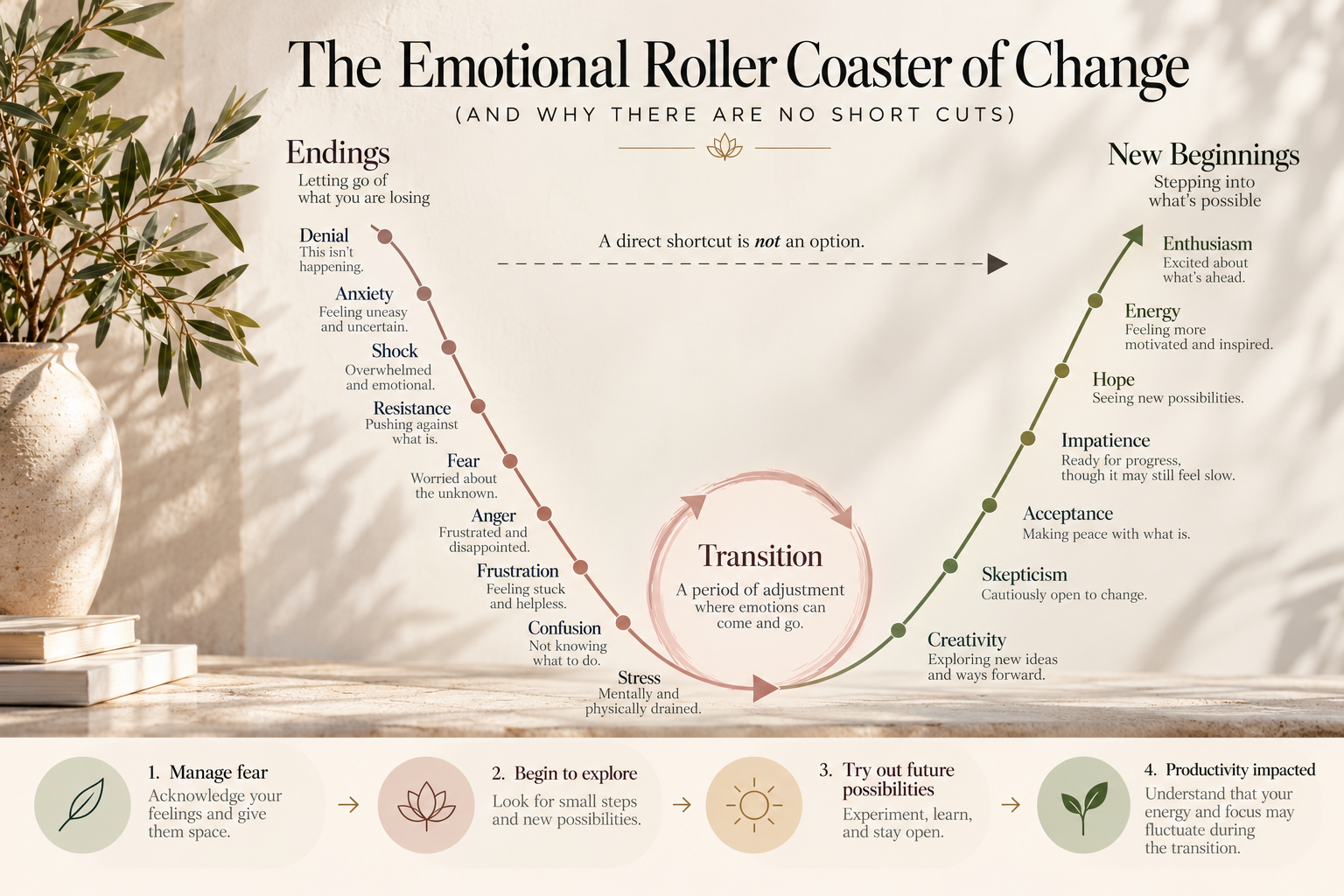
The above illustration highlights some of the emotions we may experience during a transition, from shock, denial, fear, frustration, and confusion to acceptance, hope, renewed energy, and enthusiasm.
However, these aren’t fixed stages that everyone experiences in the same order. It’s important to understand that progress through change isn’t always linear.
You might feel hopeful one day and overwhelmed the next. You may find yourself accepting a situation, only to experience another wave of frustration when something doesn’t go according to plan.
And that’s perfectly OK.
The purpose of understanding these emotional patterns isn’t to determine which stage we should be in. Rather, it’s to recognize that our responses can fluctuate and that experiencing difficult emotions doesn’t necessarily mean we’re moving backward.
6 Practical Ways to Navigate Change With Greater Ease
While we can’t always control what happens in life, we can influence how we respond to it.
Below are six ways that might help to navigate life’s transitions a little more manageable:
1. Acknowledge What You’re Feeling
When faced with an uncomfortable change, our first instinct may be to push away difficult emotions or convince ourselves that we should be handling things better.
But ignoring our feelings doesn’t necessarily make them disappear.
Instead, acknowledge what you’re experiencing without immediately judging or trying to change it.
Take the time to reflect and get clear on your feelings. Are you anxious about the future? Disappointed about something you’ve lost? Perhaps you’re feeling both excited and frightened about what’s ahead.
You don’t have to like what’s happening to acknowledge that it’s happening. And accepting your current reality doesn’t mean resigning yourself to it forever.
It simply allows you to begin responding to the situation as it is, rather than spending all your energy wishing it were different.
2. Focus on What You Can Control

One of the most empowering things we can do during periods of change is distinguish between what is within our control and what isn’t.
Let’s say you’ve unexpectedly lost your job.
You may have little control over the company’s decision or how quickly a new opportunity becomes available. But you can update your résumé, reach out to your network, explore opportunities, or develop new skill in the meantime.
You may not be able to control the outcome, but you can take meaningful action toward it.
When things feel overwhelming, take a step back and ask yourself: What’s one thing I can do today that would help me move forward?
3. Create Stability Where You Can
When one area of life feels uncertain, maintaining some consistency in other areas can be incredibly helpful.
Simple habits such as going for a morning walk, maintaining a regular sleep schedule, or setting aside time for mindfulness can provide a comforting sense of familiarity.
Think of these routines as anchors that’ll help ground you. They won’t prevent the waves of change from coming, but they can help you feel a little more grounded as you navigate them.
4. Take Small, Manageable Steps
Sometimes, change feels overwhelming because we’re focusing on everything that needs to happen rather than what we can realistically do next.
Let’s say you’d like to adopt a healthier lifestyle. You might envision exercising five times a week, preparing every meal from scratch, and completely transforming your daily routine.
While your intentions are admirable, attempting to overhaul everything at once can quickly become overwhelming and/or exhausting.
So instead, why not begin with something ‘smaller’. A couple of examples could be taking a fifteen-minute walk each day or adding more vegetables to your meals. And once it becomes part of your routine, gradually build on it.
The same principle applies to career transitions, personal goals, and many other life changes.
Small steps may not seem particularly impressive in the moment, but their cumulative impact can be significant.
5. Be Open to Different Perspectives and Possibilities

Sometimes, our resistance to change comes from the story we’re telling ourselves about what it means.
We might interpret an unexpected setback as a failure, a change in direction as wasted effort, or an unfamiliar opportunity as something we’re not capable of handling.
But what if we challenged those assumptions?
Losing a job, for example, can be genuinely difficult, particularly when it creates financial pressure. Yet, it doesn’t necessarily mean your professional journey has come to a standstill.
Perhaps it opens the door to exploring a different industry or pursuing opportunities that are more align with your values or interests.
This isn’t about pretending every difficult experience is a blessing in disguise. It’s about recognizing that our initial interpretation isn’t always the only one.
Read More: The Unexpected Yet Powerful Advantages of Challenges
6. Give Yourself Time and Seek Support When Needed
We often underestimate how much time and energy adapting to change can require.
Even positive transitions can disrupt our routines, challenge our expectations, and temporarily affect our confidence or productivity.
Think about starting a new job. You may be thrilled about the opportunity, but learning unfamiliar systems, adjusting to different responsibilities, and getting to know new people can still be exhausting.
That doesn’t mean you’ve made the wrong decision. It means you’re adjusting.
And remember, you don’t have to go through it all on your own. Be patient with yourself, and don’t hesitate to seek support from friends, family, a mentor, coach, or qualified professional when needed.
When Change Doesn’t Happen, Perhaps It’s Time to Create It

So far, we’ve talked about adapting to changes that happen in our lives. But there’s another side to this conversation that’s just as important.
What happens when the change we’re hoping for never arrives?
Perhaps you’ve been unhappy in your job for years, hoping things will eventually improve. Maybe you’re waiting for the right moment to begin taking better care of your health or pursue a long-held ambition.
Sometimes, circumstances genuinely require patience. We may need more resources, information, or stability before making a significant move.
But other times, we find ourselves waiting simply because taking action feels uncomfortable.
And while we wait, life continues moving forward. This brings us to an important realization: Indecision is also a decision.
Consider someone who knows their company is experiencing serious financial difficulties.
They could continue hoping the situation improves, and perhaps it will. But they could also begin exploring other opportunities, updating their résumé, or strengthening their professional network while remaining in their current position.
Taking these steps doesn’t mean they’ve abandoned hope. It means they’re preparing themselves for different possibilities.
And the same certainly applies to our personal lives. We don’t always have to wait until we’re deeply unhappy, completely exhausted, or hit rock bottom before making a change.
Sometimes, recognizing that something no longer serves us is reason enough to begin considering a different path.
After all, we may not always get to choose what happens to us, but we can often choose what we do next.
Embracing Change Doesn’t Mean You Have to Like It
We often hear that we should embrace change, welcome new beginnings, and see every transition as an opportunity.
And while that can be an empowering perspective, it isn’t always realistic.
The reality is that some changes can be painful. Some are deeply disappointing. Others bring challenges we would gladly have avoided.
You don’t have to jump for joy when losing your job, ending a meaningful relationship, or facing an unexpected setback. And you also don’t have to immediately identify a valuable life lesson in every difficult experience.
Sometimes, simply acknowledging what has happened and finding a way forward is enough.
Embracing change doesn’t have to mean being enthusiastic about everything life throws your way.
It can mean remaining open to adapting, learning, and making the most of the circumstances you’re facing.
And when change is something you choose, embracing it may mean accepting the temporary discomfort that comes with building a life that’s more aligned with your needs, values, and aspirations.
Final Thoughts: Change Is Inevitable, but How We Navigate It Matters

Whether we realize it or not, change is happening all around us and within us.
Some changes unfold so gradually that we barely notice them. Others arrive unexpectedly and require us to rethink everything we thought we knew.
And sometimes, the most meaningful changes begin with a decision to stop waiting for our circumstances to improve and start taking steps toward something different.
We won’t always get to choose what changes in our lives, when it happens, or how things turn out. That said, we can always learn to approach transitions with greater awareness, flexibility, and self-compassion.
We can acknowledge difficult emotions without allowing them to dictate every decision, focus on what we can influence, and remain open to possibilities we may not have considered before.
So, the next time you find yourself facing change, whether it’s something you’ve chosen or something life has brought your way, consider asking yourself: What can I do to make this transition a little easier? And how can I use this experience to move forward in a way that feels right for me?
You may not have all the answers right away. And there’s no need to. Simply take it one step and one day at a time.
Need a Little Extra Support?
If you’re navigating a period of uncertainty or transition, simply taking a few moments to reconnect with yourself can help you feel more grounded.
Our Let It Unfold Guided Meditation offers a gentle opportunity to release some of the pressure of needing to know exactly what comes next and approach the unknown with greater trust & clarity.
Read More: Feeling Overwhelmed? 7 Simple Yet Effective Ways to Calm Your Nervous System
Are you facing a significant life transition and looking for personalized guidance? Book your FREE discovery call with me, a Certified Holistic Wellness Coach and see how Holistic Wellness Coaching can support you!